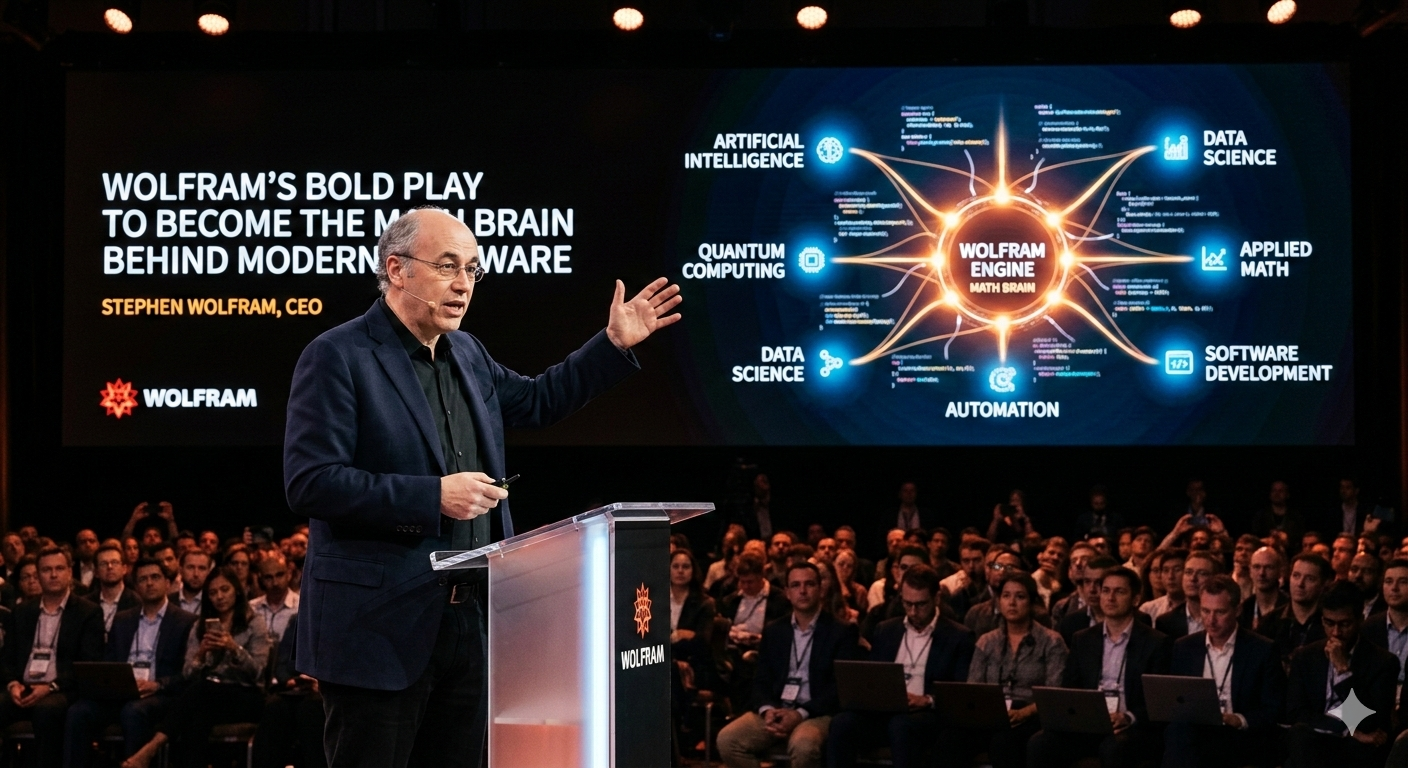
The Computational Powerhouse Opens Its Doors

Here’s what caught my attention: Wolfram Research isn’t just talking about licensing deals anymore. They’re fundamentally restructuring how their computational technology can be integrated into other software systems. After decades of Mathematica and Wolfram Alpha being standalone powerhouses, the company’s now saying ‘hey, use our math engine as your foundation.’
What’s interesting here is the timing. We’re seeing an explosion in software that needs serious computational chops, and most developers are cobbling together solutions with open-source libraries and prayer. Wolfram’s essentially saying they’ve got a 30-year head start on symbolic computation, and they’re ready to let others build on top of it.
I think this represents a massive strategic shift for Wolfram. Instead of competing with every math-heavy application out there, they’re positioning themselves as the computational substrate. It’s like Intel deciding to just make really good chips and let everyone else worry about the computers.
Why This Matters for Developers Right Now

The thing is, building mathematical reasoning into software is brutally hard. I’ve watched countless startups burn through funding trying to recreate basic symbolic math capabilities that Wolfram figured out in the 1990s. Most developers end up using NumPy or similar libraries, which are great for number crunching but terrible at the kind of symbolic reasoning that makes software truly intelligent.
Wolfram’s offering something different here – access to their entire computational knowledge base and reasoning engine as building blocks. That means developers could theoretically plug in sophisticated mathematical problem-solving without reinventing calculus. We’re talking about natural language math processing, symbolic computation, and knowledge graphs that actually understand relationships between concepts.
What’s really compelling is how this could accelerate development cycles. Instead of spending months building basic mathematical foundations, teams could focus on their actual product innovations. It’s like the difference between mining your own silicon and buying processors from a chip manufacturer.
The integration challenges will be real, though. Wolfram’s technology has always been powerful but complex. The success of this initiative will depend entirely on how well they can package this computational intelligence for developers who aren’t mathematical computing experts.
The Competitive Landscape Just Got Interesting

Here’s where things get spicy. Google, Microsoft, and others have been building their own computational capabilities for years, but they’ve kept them locked inside their ecosystems. Wolfram’s making a bet that opening up their technology will create more value than hoarding it. It’s a classic platform play, and if it works, it could put serious pressure on the big tech companies.
I’m particularly curious about how this affects companies like Symbolab, Desmos, or even Khan Academy. These platforms have built businesses around mathematical computation, but they’re mostly using their own limited engines. If developers can suddenly access Wolfram’s decades of computational research, why would they build inferior math capabilities from scratch?
The enterprise implications are huge too. Companies doing financial modeling, scientific research, or engineering simulations often license expensive specialized software. If Wolfram’s technology becomes accessible as infrastructure, we could see a wave of more affordable, specialized applications that compete directly with established players like MATLAB or SAS.
What’s smart about Wolfram’s approach is they’re not trying to compete with application developers – they’re trying to enable them. It’s the difference between building competing restaurants and selling kitchen equipment to all the restaurants. Much better margins, less direct competition.
The Technical Reality Check

Now, let’s be honest about the challenges here. Wolfram’s technology is incredibly sophisticated, but it’s also notoriously complex to work with. The Wolfram Language is powerful but has a steep learning curve. If they’re serious about this foundation tool approach, they’ll need to create abstraction layers that make their computational engine accessible to developers who aren’t PhD mathematicians.
Performance is another consideration. Wolfram’s systems are built for accuracy and comprehensiveness, not necessarily speed. In a world where applications need to respond in milliseconds, there’s a question about whether Wolfram’s computational approach can scale to real-time applications. They’ll need to figure out caching, preprocessing, and optimization strategies.
Integration complexity could be the make-or-break factor. Developers want simple APIs and clear documentation. They want to solve business problems, not spend weeks learning a new computational paradigm. Wolfram’s success here will depend on how well they can hide the complexity while preserving the power.
But here’s what gives me hope: Wolfram has always been obsessive about making complex mathematics accessible. Mathematica succeeded because it made symbolic computation usable for working scientists and engineers. If they can bring that same design philosophy to developer tools, this could actually work.
Wolfram’s infrastructure play could fundamentally change how mathematical intelligence gets built into software. If they can package three decades of computational research into developer-friendly tools, we’re looking at a potential platform shift that makes sophisticated mathematical reasoning as common as database connectivity. The question isn’t whether the technology is powerful enough – it’s whether Wolfram can make it accessible enough for widespread adoption.