Why Ladybird’s Rust Move Matters More Than You Think
Here’s the thing about browser engines: they’re incredibly complex beasts that handle everything from parsing HTML to managing memory across thousands of tabs. When Andreas Kling announced Ladybird’s shift to Rust, he wasn’t just picking a trendy language—he was making a bet on safety and performance that could reshape how we think about browser architecture.
What’s interesting here is the timing. While Chrome dominates with Blink and Firefox soldiers on with Gecko, Ladybird represents something different: a clean-slate approach that’s not beholden to decades of legacy code. The Rust adoption puts them in the same camp as emerging systems projects that prioritize memory safety without sacrificing speed.
I think this move signals something bigger happening in systems programming. We’re seeing a generational shift where new projects default to Rust for anything that needs to be both fast and secure. Ladybird’s decision validates what many of us in the industry have been saying—Rust isn’t just hype, it’s becoming the pragmatic choice for serious systems work.
The Technical Reality Behind the Hype
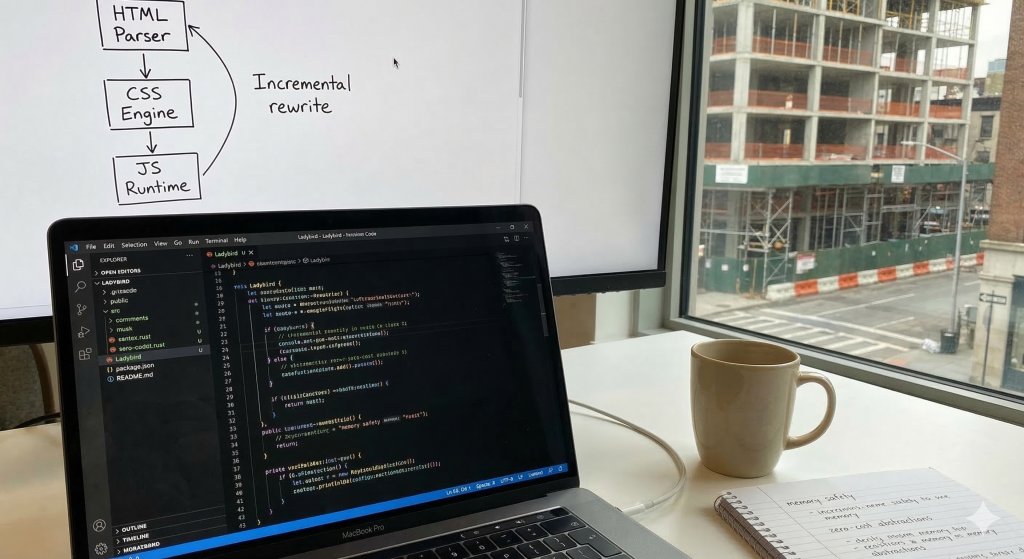
Let me be clear about what this actually means in practice. Rewriting a browser engine isn’t like switching JavaScript frameworks—it’s more like rebuilding the foundation of a skyscraper while people are still living in it. The Ladybird team is essentially starting over with core components like the HTML parser, CSS engine, and JavaScript runtime.
The Rust ecosystem has matured enough to make this feasible. Projects like Servo proved that you can build performant web engines in Rust, even if Mozilla’s broader strategy shifted away from it. Ladybird gets to learn from those experiments without carrying the political baggage of a large organization.
What’s particularly smart is how they’re approaching this incrementally. Rather than a big-bang rewrite, they’re rebuilding components piece by piece. This lets them maintain momentum while gradually proving out the new architecture. It’s the kind of methodical approach that actually ships rather than just generating GitHub stars.
The performance implications are genuinely exciting. Rust’s zero-cost abstractions mean they can write safer code without the overhead that traditionally comes with memory safety. For a browser engine that needs to parse untrusted web content all day long, that’s not just nice to have—it’s essential.
Competition and Market Positioning
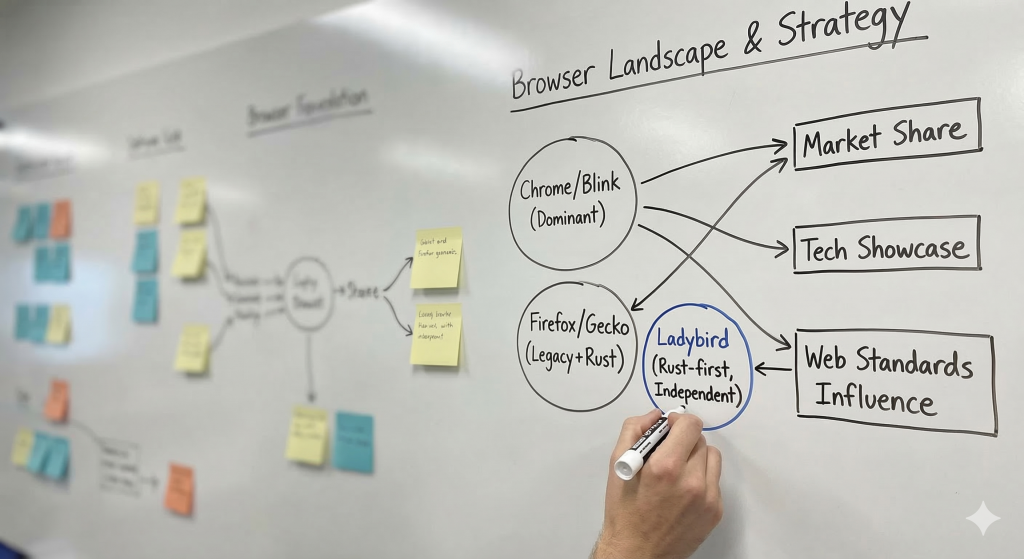
Here’s where things get really interesting from a competitive standpoint. Google’s Chrome team has hundreds of engineers working on Blink, and they’ve been talking about memory safety improvements for years. Meanwhile, Ladybird’s small team is leapfrogging that entire conversation by starting fresh with Rust.
I don’t think Ladybird is trying to compete directly with Chrome on market share—that would be suicide. Instead, they’re positioning themselves as the technical showcase for what modern browser architecture should look like. Think of it as the Tesla Roadster moment for browsers: proving the technology works before others scale it up.
The open source angle matters here too. While Chrome is technically open source through Chromium, Google’s control is absolute. Ladybird offers something different: a truly independent rendering engine that web developers can actually influence. That’s valuable for the long-term health of web standards.
What’s fascinating is how this positions them against other alternative browsers. Most Chrome alternatives are just reskins of Chromium. Ladybird and Firefox are increasingly the only games in town for actual engine diversity, and Ladybird’s Rust foundation might give them advantages Firefox can’t easily replicate.
What This Means for Developers and Users
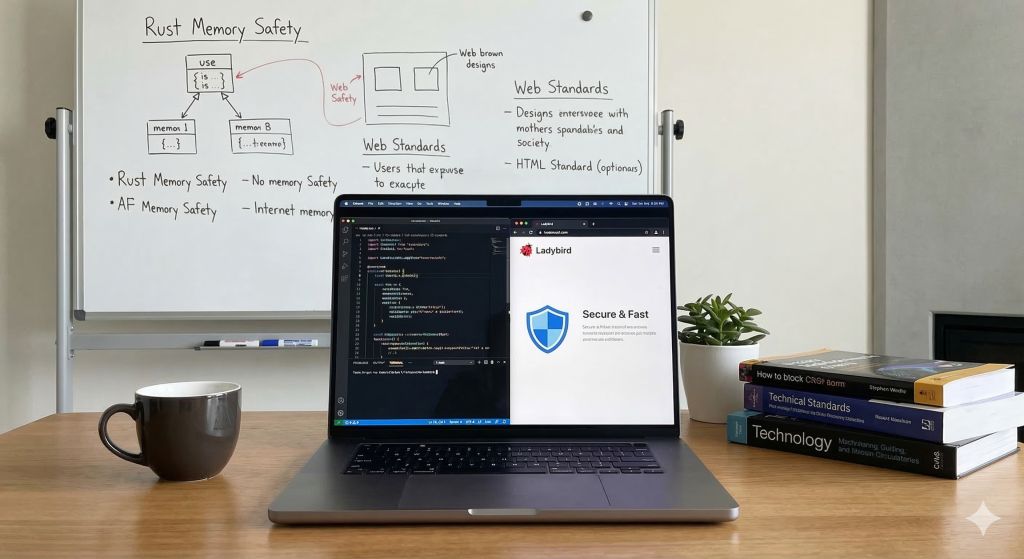
For web developers, this is both exciting and slightly terrifying. Another rendering engine means another set of quirks to test against, but it also means less monoculture. If Ladybird gains traction, it could pressure Chrome to be more standards-compliant rather than just implementing whatever Google thinks is best.
The security implications are huge for end users, even if they never think about it. Memory safety bugs are responsible for roughly 70% of serious security vulnerabilities in browsers. Rust’s ownership model makes entire classes of these bugs impossible. That’s not theoretical—it’s a fundamental architectural advantage.
Performance-wise, users should eventually see benefits in areas like startup time and memory usage. Rust’s predictable performance characteristics mean fewer garbage collection pauses and more consistent behavior under load. For anyone who’s ever had their browser slow to a crawl with too many tabs, that’s a tangible improvement.
The bigger picture here is about platform independence. Right now, web standards are effectively whatever Google decides they should be. A viable alternative engine built with modern tooling could shift that balance back toward actual standards bodies rather than corporate interests.
The Ladybird project represents more than just another browser—it’s a bet on what the future of systems programming looks like. Whether they succeed in building a viable Chrome alternative remains to be seen, but their technical choices are already influencing how the industry thinks about memory safety and performance. In a world where browser choice increasingly matters for both security and innovation, that influence might be their most important contribution regardless of market share.